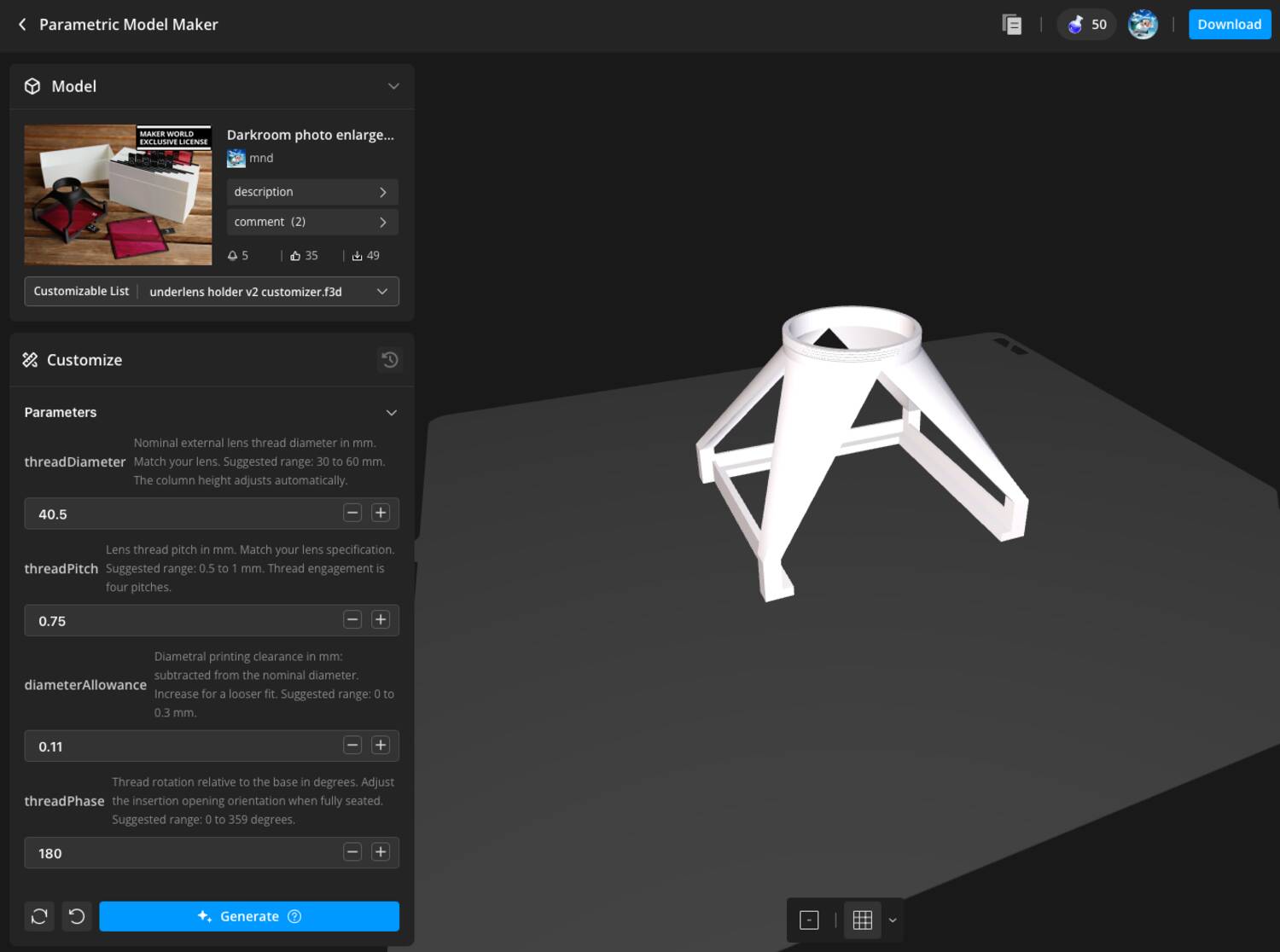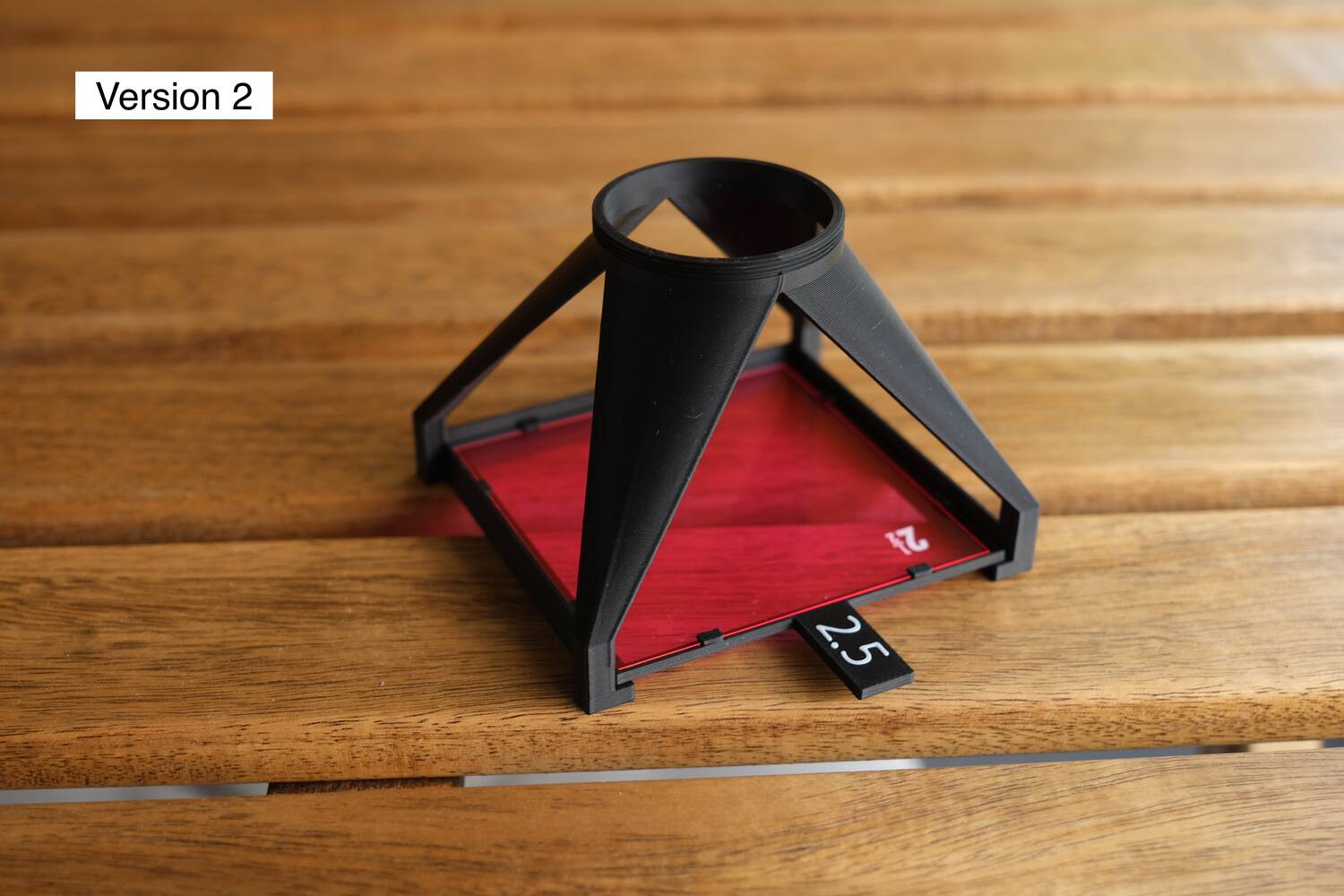
About a year ago, I published my under-lens filter holder for photo enlargers on MakerWorld and wrote a blog post about it. Since then, I’ve been using it regularly for my darkroom printing sessions. The original version was designed for my own lens, which has a 40.5 mm thread. Later, someone mentioned modifying it for a different thread size. I asked if they could share their version as a print profile, but I never heard back. That also made me realize: maintaining dozens of fixed variants doesn’t scale. What you really want is a parametric model that lets anyone set their own thread size.
The obvious question is: what took me so long? Well, the original version was literally my first 3D model, built in Tinkercad, a CAD program for kids. It’s great for getting started, but making changes there is difficult, let alone creating a parametric design. Rebuilding it from scratch in Autodesk Fusion 360 felt like a chore I didn’t want to take on, especially since my own problem was already solved. I hoped someone in the community with more CAD experience than I had would create a parametric remix, but it didn’t happen.
GPT-6 Astra to the rescue! 🔗
Recently, OpenAI released its new GPT-6 Astra model, which was advertised as being good at 3D modeling, so I decided to give it a try. I also discovered an MCP server that lets Codex work directly with Fusion 360.
MCP (Model Context Protocol) is a standard that lets AI tools connect to and interact with external software without using a user interface.
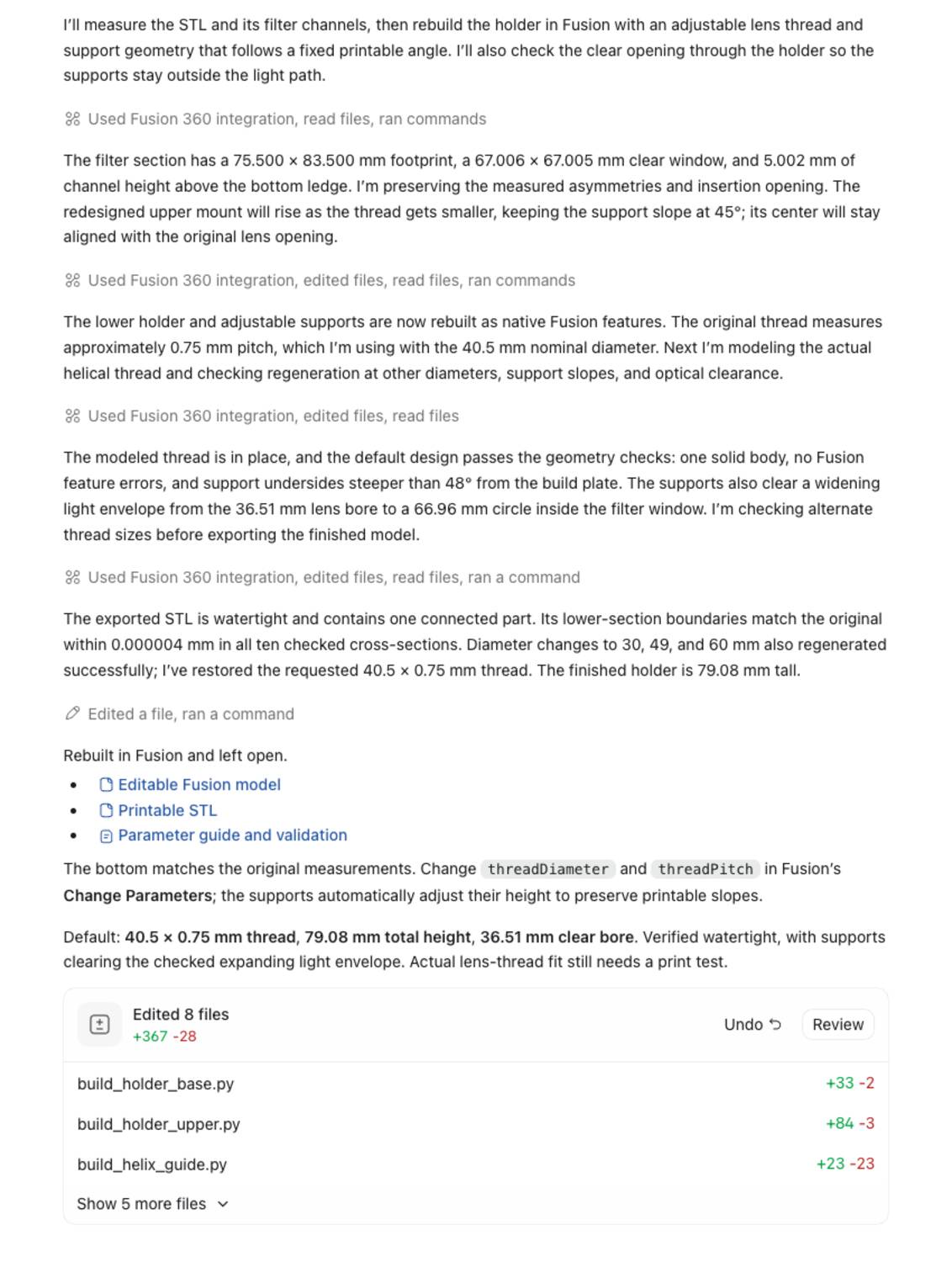
I sent Codex the STL from the original holder and asked it to rebuild the model in Fusion, keeping the exact dimensions of the filter drawer section while making the thread parametric. About ten minutes later, I had a new Fusion model and a proper parameter table. Changing a value in the table makes Fusion recalculate the model. Here is a recording of the steps Codex took in Fusion after reading the dimensions from the original model.
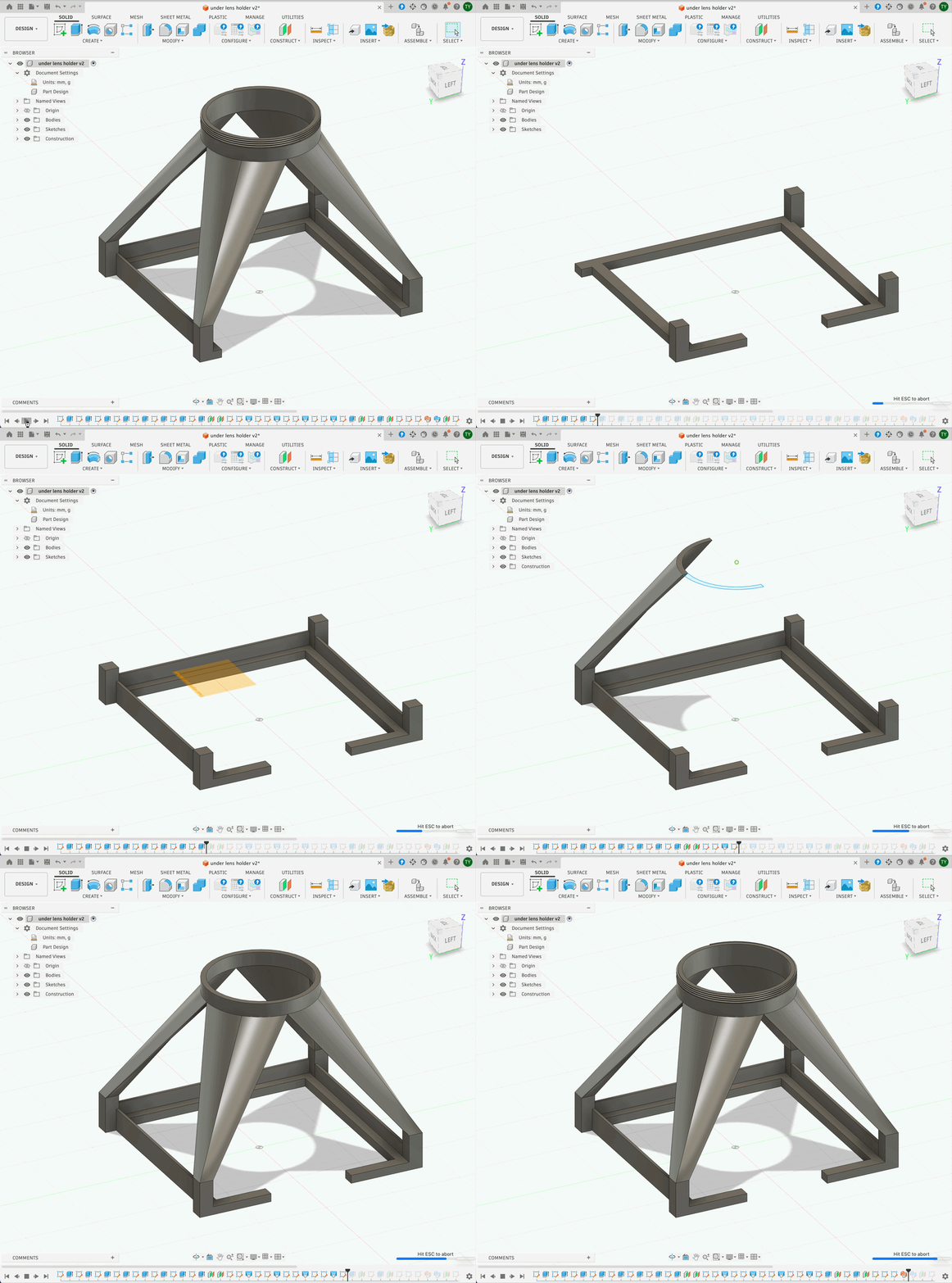
Additionally, I slightly improved the geometry by adjusting the collar and bottom ledge heights and removing both protruding tabs.
The parametric F3D model is now integrated with MakerWorld’s web customizer. You don’t even need to install Autodesk Fusion: you can generate a custom holder directly in your browser or the Bambu Handy mobile app. The new version is available on MakerWorld. Before publishing the model, I 3D-printed one for myself and tested it in the darkroom. It came out perfectly clean without supports, even better than the original, and feels sturdier as well.