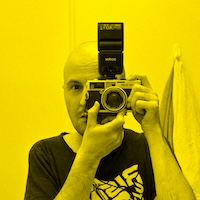
Almost in focus
Two years ago, my wife and I went to a retrospective exhibition of photographs by Sabine Weiss. After the exhibition, my wife pointed to a poster of Sabine holding her Rolleiflex TLR camera and asked what kind of camera it was and why it needed two lenses. I told her it was a medium-format camera and explained that one lens takes the photo while the other is used for the viewfinder. Unlike in an SLR, the mirror doesn’t move out of the way when you take a picture.
Read more ...
Read more ...
About a year ago, I published my under-lens filter holder for photo enlargers on MakerWorld and wrote a blog post about it. Since then, I’ve been using it regularly for my darkroom printing sessions. The original version was designed for my own lens, which has a 40.5 mm thread. Later, someone mentioned modifying it for a different thread size. I asked if they could share their version as a print profile, but I never heard back. That also made me realize: maintaining dozens of fixed variants doesn’t scale. What you really want is a parametric model that lets anyone set their own thread size.
Read more ...
Read more ...
From my experience, photos of unevenly lit scenes are usually the most difficult to print in the darkroom due to the significant differences in the negative’s density between highlights and shadows. In film photography, as opposed to a digital workflow, one needs to preserve shadows instead of highlights. When approaching an unevenly lit scene, it’s better to adjust the exposure for the shadows to make them denser on the negative; otherwise, the shadow areas will be transparent and lack detail.
Read more ...
Read more ...
About six months ago, my wife discovered a Japanese indie band called 超☆社会的サンダル (Chō shakai-teki sandaru) and became obsessed with them. We thought it would be cool to see them live while we were in Tokyo this winter. Unfortunately, the band didn’t have any scheduled gigs, but their vocalist, Onizawa Mashiro, suddenly announced an acoustic solo concert. We were supposed to meet a friend that day who coincidentally lives in the same district where the venue is, so we invited him to join us. This entire story almost didn’t happen because all the tickets were booked immediately. Our friend only managed to book a single ticket for himself, and he hasn’t even received a confirmation for it.
Read more ...
Read more ...
When I first started developing black and white film at home, I got a starter kit with all the necessary chemicals and tools. It came with Rodinal and a brochure that guided me through the development process, including an explanation of agitation method used by Ansel Adams. The instructions suggested agitating the tank for 10 seconds every minute by twisting the tank around its axis while turning it upside down. This method worked perfectly for me with Rodinal and, later, with HC-110.
Read more ...
Read more ...
In January, I published a virtual photo album with photos from Kyushu, Chūgoku, and Kansai that I shot entirely on black and white film. While the digital album is convenient for sharing, I wanted to have physical prints as well. This project became my main motivation for building a darkroom at home. After eight months of occasional darkroom sessions, I’m sitting with a stack of 104 gelatin silver prints on my table and a strong feeling of accomplishment. It was my first long printing project, so I wanted to share a few things I learned.
Read more ...
Read more ...
Recently, I brought my medium format Bronica S2a camera and a 135mm f/3.5 Nikkor-Q lens with me to a lake to take some landscape photos. The waist-level viewfinder that I use with this camera requires as much light as possible to make focusing easier. So it doesn’t matter which aperture is set on the lens, the camera always keeps it wide open and only closes the blades when taking the photo or while the depth of field preview button is pressed.
Read more ...
Read more ...
Once, I wanted to buy a lens hood for a 55-year-old Yashica Mat-124G. To my surprise, an original hood cost half as much as I paid for the camera body. Maintaining analog camera gear can be tricky, as parts are no longer produced and often have to be salvaged from donor cameras. This is where 3D printing becomes especially useful. It also allows you to design entirely new tools that were never available in the first place.
Read more ...
Read more ...